de
de zh
zh fr
fr es
es tr
tr pt
pt nl
nl ru
ru uk
uk hi
hi
Record Adjustment: Bitcoin Network Reclaims February Losses
The mining difficulty for the world's leading cryptocurrency has demonstrated a sharp recovery. According to CoinWarz data as of February 20, mining difficulty surged by approximately 15%, reaching a level of 144.4 trillion. This spike fully offset the 11% drop recorded earlier this month, which had marked the most significant decline since the "great migration" of miners from China in 2021.
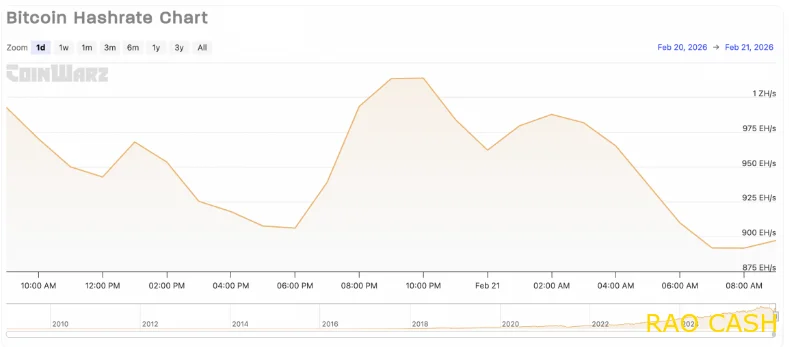
The temporary slump was triggered by anomalous winter storms that swept across large portions of the United States in late January. The severe weather disrupted power grid stability, forcing major industry players to temporarily de-energize their hardware. Specifically, Foundry USA — the largest mining pool by hashrate — saw its computing power slashed nearly in half, from 400 EH/s to 198 EH/s, before metrics returned to normal.
Adjustment Mechanism and Network Security
The Bitcoin algorithm is programmed for self-regulation: difficulty recalibrates every 2,016 blocks (approximately every two weeks). This ensures that the average block production time remains at roughly 10 minutes.
As American data centers resumed operations following the natural disaster, the network's total hashrate trended sharply upward. This inevitably triggered an upward difficulty adjustment. For the industry, this is a double-edged sword: on one hand, increased difficulty strengthens the network's defense against attacks; on the other, it raises operational costs for mining each new BTC, putting pressure on miner margins.
Survival Strategy: How Miners Profit from Power Shutdowns
Paradoxically, forced downtime due to storms does not always translate into losses for mining firms. Many large-scale U.S. miners utilize flexible power contracts and participate in demand-response programs. During peak grid loads, they shut down their equipment and resell contracted electricity back to municipal grids at high market rates.
The Case of LM Funding America
A prominent example of this model's efficiency is LM Funding America. According to CEO Bruce Rodgers, during the storm, its Fern subsidiary redirected power back to the public grid. The result was striking: in just one weekend, the company generated revenue exceeding 25% of its typical quarterly earnings from power curtailment programs. This confirms that modern mining is becoming a vital tool for balancing energy systems.
Value for the Reader
The recovery of difficulty to record levels demonstrates the high resilience of the Bitcoin network: even massive natural disasters in a key mining region cause only short-term fluctuations. Investors should note that rising difficulty increases the production cost of Bitcoin, which historically provides fundamental support for the asset's price, as miners tend to hold coins rather than sell them below the cost of production.
Rao Cash Analytical Expertise: Event Context
The latest data presented in Bitcoin Mining Difficulty Recovers by 15% Following US Winter Storms! clearly reflects the ongoing shifts in the balance of power within the global cryptocurrency market. The Rao Cash information portal monitors these market triggers 24/7, delivering high-quality crypto news, real-time on-chain statistics, and expert blockchain industry insights to our audience. We assist readers in promptly identifying long-term trends while filtering out speculative noise and market manipulation.
Analyzing the event requires a comprehensive approach, including liquidity assessment, exchange trading volume tracking, and smart contract security audits. A vital element of our internal ecosystem is the utility RAO token—a digital asset integrated into our content infrastructure that unlocks access to professional data processing tools. By conducting granular technical analysis, our team helps investors gain a deeper understanding of institutional capital flows across the DeFi and Real World Asset (RWA) tokenization sectors.
By exploring the analytical breakdown on our multi-language platform, you gain access to verified, real-time insights. Our expert editorial group prioritizes objectivity and factual accuracy, establishing a trustworthy information foundation for making informed decisions in a rapidly evolving Web3 economy.