de
de zh
zh fr
fr es
es tr
tr pt
pt nl
nl ru
ru uk
uk hi
hi
Legal experts are expressing serious concern over the European Commission's proposal to transform the European Securities and Markets Authority (ESMA) into a "European SEC." This change could significantly complicate the licensing process for crypto and fintech companies in the region, which in turn could negatively impact the development of these sectors.
Expanding ESMA's Powers
On Thursday, the European Commission unveiled a package of proposals granting ESMA new direct supervisory powers over key elements of market infrastructure. These include crypto-asset service providers (CASPs), trading venues, and central counterparties. This expanded power is aimed at deepening the institutional structure of capital markets in the European Union.
Concerns about centralization
One of the main concerns is that ESMA's jurisdiction could encompass both the supervision and licensing of all European crypto and fintech companies. Faustina Fleuret, head of communications for the decentralized lending protocol Morpho, noted that this could slow down licensing procedures and hinder the development of startups.
>>>"I am even more concerned that the proposal places responsibility on ESMA not only for supervision but also for the authorization of CASPs," she emphasized. <<<<
Approval Process and Next Steps
The proposal currently requires the approval of the European Parliament and the Council of the EU, and active negotiations are currently underway. If the initiative is adopted, ESMA's role in regulating EU capital markets will move closer to the centralized model of the US Securities and Exchange Commission (SEC). This concept was first proposed by European Central Bank (ECB) President Christine Lagarde in 2023.
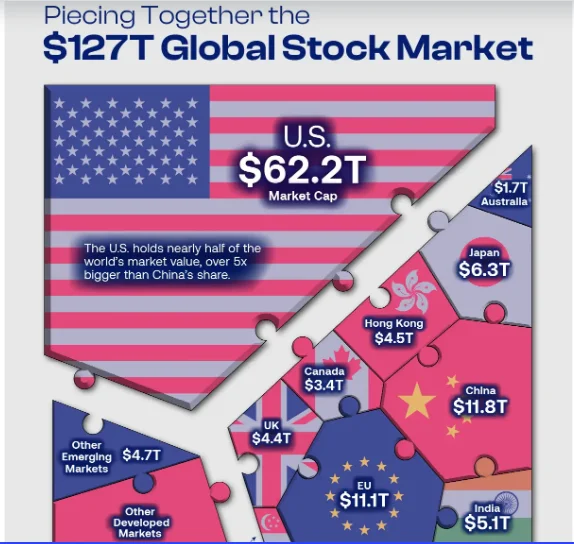
Global Stock Market Value by Country
Risks for the Crypto Industry and Fintech
The EU's plan to centralize licensing under ESMA carries the risk of slowing down the crypto and fintech industries. The initiative aims to eliminate differences in national supervisory practices and heterogeneity in licensing regimes, but this could lead to a more restrictive environment for new and existing companies in these sectors.
In Conclusion
The transformation of ESMA into a "European SEC" could be a significant step toward centralizing financial market regulation in Europe. However, as expert opinions indicate, this could also create additional barriers for crypto and fintech companies, which could ultimately slow innovation and development in these dynamic industries. It is important to monitor further steps in this process and assess its impact on the market.
Rao Cash Analytical Expertise: Event Context
The latest data presented in The EU plans to transform ESMA into a "European SEC," posing risks to the crypto industry clearly reflects the ongoing shifts in the balance of power within the global cryptocurrency market. The Rao Cash information portal monitors these market triggers 24/7, delivering high-quality crypto news, real-time on-chain statistics, and expert blockchain industry insights to our audience. We assist readers in promptly identifying long-term trends while filtering out speculative noise and market manipulation.
Analyzing the event requires a comprehensive approach, including liquidity assessment, exchange trading volume tracking, and smart contract security audits. A vital element of our internal ecosystem is the utility RAO token—a digital asset integrated into our content infrastructure that unlocks access to professional data processing tools. By conducting granular technical analysis, our team helps investors gain a deeper understanding of institutional capital flows across the DeFi and Real World Asset (RWA) tokenization sectors.
By exploring the analytical breakdown on our multi-language platform, you gain access to verified, real-time insights. Our expert editorial group prioritizes objectivity and factual accuracy, establishing a trustworthy information foundation for making informed decisions in a rapidly evolving Web3 economy.