de
de zh
zh fr
fr es
es tr
tr pt
pt nl
nl ru
ru uk
uk hi
hi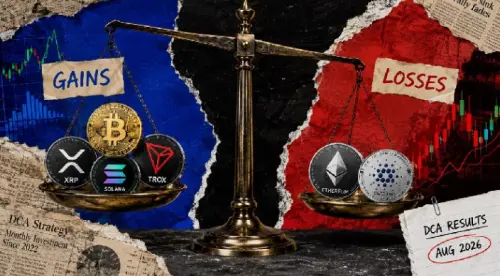
The global cryptocurrency market in August 2026 clearly demonstrates to investors the critical importance of proper asset selection when employing conservative financial strategies. The systematic capital accumulation method known as "Buy the Dip," highly popular within the community, has brought deep disappointment to those market participants who staked on Ethereum and Cardano since the beginning of 2022. According to long-term statistical studies by the authoritative analytical agency CryptoRank, these blockchain platforms failed to meet the expectations of retail contributors.
Regular mathematical calculations reveal that a hypothetical investor who allocated a fixed amount of 100 dollars monthly to purchase Ethereum from January 2022 to August 2026 would have deployed a total of 5,600 dollars. However, due to prolonged stagnation and the absence of a full-scale price reversal, the investor's portfolio would have shrunk to 4,898 dollars, recording a net loss of 12.5%. The situation with the Cardano token turned out to be even more critical: a similar DCA strategy would have preserved only 2,616 dollars, which is equivalent to a catastrophic loss of 53.3% of the invested funds.
Paradoxes of Dollar-Cost Averaging and Triumphant Investing in Alternative Blockchains
Completely different, highly profitable dynamics over the long distance were demonstrated by other popular digital assets, proving the superiority of their economic models. The exact same 5,600 US dollars, distributed in equal installments into the native $TRX token of the Tron network, would have increased to an impressive 16,521 dollars by the end of the reporting period, yielding a net profit of 195%. The monthly accumulation strategy for Bitcoin ($BTC) allowed investors to lock in a final balance of 8,660 dollars, the payment token $XRP grew to 8,465 dollars, and high-speed Solana ($SOL) reached the 8,025 dollars mark, ensuring a return above 40% in all three cases.
Key events and market factors: such striking differences in financial results vividly demonstrate that classical dollar-cost averaging (DCA) effectively smooths out local price peaks but never guarantees automatic profit extraction. Regular purchases of cryptocurrencies for a fixed amount did indeed allow traders to accumulate a much larger quantity of coins during prolonged market downturns. Nevertheless, the final investment success of each specific portfolio still directly depended on the fundamental strength of the asset and the depth of its subsequent recovery.
The 2024 Institutional Expansion as the Main Trigger of a Large-Scale Price Reversal
The bulk of the accumulated investment profit recorded before the current stabilization was generated during the large-scale cryptocurrency rally of 2024. It was during this period that the value of portfolios, which had been systematically formed by retail and large investors over the previous two years, skyrocketed to their local maximums. By the end of 2024, the hypothetical Solana portfolio was valued at 17,728 dollars, while accumulations in $XRP tokens were worth 14,345 dollars, in Bitcoin — 10,193 dollars, and in Cardano — 7,251 dollars.
This rapid surge in capitalization coincided in time with a fundamental expansion of institutional access to the digital currency sector by the largest American investment funds. In January, the US Securities and Exchange Commission (SEC) officially approved the first spot exchange-traded products (ETFs) based on Bitcoin, and in May, it approved similar spot instruments for Ethereum. This provided conservative capital with legal, strictly state-regulated gateways for safe operations with the world's largest cryptocurrency assets.
Current Cryptocurrency Market Analysis: Actual Quotes on the Binance Exchange
At the current moment, as of August 2026, a relative consolidation of prices around key historical levels is observed on the largest trading platform, Binance. The flagship of the industry, Bitcoin (BTC), trades in a stable daily range between $64,730 and $65,193, holding an average market value at the $64,810 mark, which confirms the resilience of the long-term upward trend. The second largest coin by capitalization, Ethereum (ETH), has stabilized in the region of $1,913, reflecting a temporary lull in the smart contract ecosystem before a potential autumn impulse.
In parallel with this, the specific token Rao Cash (RAO), functioning within the decentralized infrastructure of the BNB Chain, trades in today's sessions at an ultra-low price in the region of $0.000003. This asset retains a pronounced speculative status and demonstrates high local volatility, remaining a tool with an increased level of trading risk for retail traders. Strong indicators of Binance exchange reserves, confirmed by a 100% backing of client funds, guarantee overall stability and high liquidity for all key pairs.
Benefit for Readers: Practical Application of the DCA Strategy and Risk Protection
The main value of the presented analytical material for a private investor lies in the possibility of a sober assessment of the effectiveness of distributed investing without blind faith in the authority of specific blockchains. The practical experience of the last four years clearly proves that mechanical cost averaging works exclusively in tandem with a deep fundamental analysis of project viability. To create a sustainable and secure cryptocurrency portfolio, experts recommend implementing the following rules:
- Regular review of the portfolio structure: do not direct all capital into a single asset; diversify monthly purchases between protective leaders (BTC) and promising altcoins (SOL, TRX).
- Ignoring blind averaging: if a blockchain systematically loses developers and market share (like Cardano), the DCA strategy only increases your losses, turning into the holding of a knowingly weak asset.
- Reliance on institutional gateways: track the inflow of capital into official spot ETFs, as it is the large funds that form long-term price support in the market.
Summing up, it can be argued that the DCA investment strategy remains one of the best tools for retail investors, protecting against emotional purchases at the top of the market. However, the key to success is always flexibility: those market participants win who know how to timely redirect their monthly financial flows from stagnating ecosystems into technologically developing and commercially in-demand blockchain networks.
Rao Cash Analytical Expertise: Event Context
The latest data presented in Performance of the DCA Strategy: Bitcoin, XRP, Solana, and Tron Leave Ethereum Far Behind clearly reflects the ongoing shifts in the balance of power within the global cryptocurrency market. The Rao Cash information portal monitors these market triggers 24/7, delivering high-quality crypto news, real-time on-chain statistics, and expert blockchain industry insights to our audience. We assist readers in promptly identifying long-term trends while filtering out speculative noise and market manipulation.
Analyzing the event requires a comprehensive approach, including liquidity assessment, exchange trading volume tracking, and smart contract security audits. A vital element of our internal ecosystem is the utility RAO token—a digital asset integrated into our content infrastructure that unlocks access to professional data processing tools. By conducting granular technical analysis, our team helps investors gain a deeper understanding of institutional capital flows across the DeFi and Real World Asset (RWA) tokenization sectors.
By exploring the analytical breakdown on our multi-language platform, you gain access to verified, real-time insights. Our expert editorial group prioritizes objectivity and factual accuracy, establishing a trustworthy information foundation for making informed decisions in a rapidly evolving Web3 economy.