de
de zh
zh fr
fr es
es tr
tr pt
pt nl
nl ru
ru uk
uk hi
hi
Glassnode analysts reported that public companies, governments, exchange-traded funds, and exchanges account for 29.8% of the total Bitcoin (BTC) supply in circulation. The combined holdings of these entities reached a record 5.94 million BTC, highlighting the growing interest of institutional investors in the world's first cryptocurrency.
Public Company Share
Public companies hold the largest share of Bitcoin, accumulating 1.07 million BTC. The largest holder is Strategy, which manages 650,000 BTC, worth $58.8 billion at the current price, representing approximately 3% of the total supply. The top three also include MARA Holdings with 52,850 BTC ($4.7 billion) and Twenty One Capital with 37,229 BTC ($3.3 billion).

Top 10 Bitcoin Holders Among Public Companies

Currently, 190 public and private companies are accumulating Bitcoin. The amount of Bitcoin on their balance sheets has grown by 448% since January 2023, indicating a significant increase in interest from institutional investors.
Exchange and ETF Share
Exchanges are the second largest Bitcoin holders, holding 2.94 million BTC. Spot exchange-traded funds (ETFs) have accumulated 1.31 million BTC. The majority of this supply is concentrated in the iShares Bitcoin Trust from asset manager BlackRock, which holds 777,485 BTC worth $70.3 billion. A similar vehicle from Fidelity, the Wise Origin Bitcoin Fund, has accumulated 202,425 BTC worth $18.3 billion. Grayscale's Bitcoin Trust holds the third-largest amount of BTC, holding 167,010 BTC worth $15.1 billion.
Top 10 Bitcoin ETF Holders

Government Share
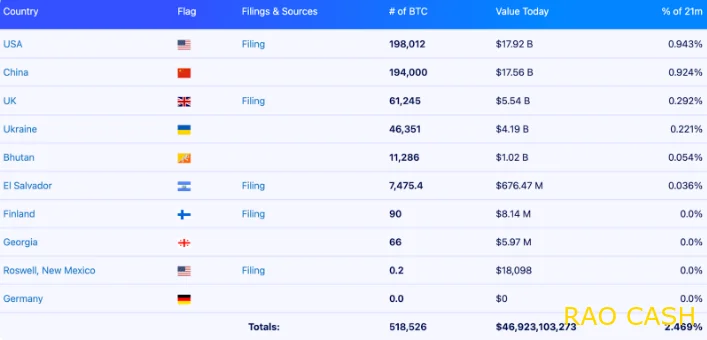
Governments of various countries hold 0.6 million BTC. The US leads the way with 198,012 BTC worth $17.9 billion. China holds 194,000 BTC worth $17.5 billion, and the UK is third with 61,245 BTC worth $5.5 billion.
In Conclusion
The concentration of nearly 30% of Bitcoin's supply in the hands of large institutions underscores the growing interest in cryptocurrencies among public companies and governments. This could have a significant impact on the market, especially given the changing macroeconomic environment and increasing volatility. Institutional investment continues to shape the future of Bitcoin and its role in the global financial system.
Rao Cash Analytical Expertise: Event Context
The latest data presented in Large institutions have concentrated almost 30% of Bitcoin's supply — Glassnode clearly reflects the ongoing shifts in the balance of power within the global cryptocurrency market. The Rao Cash information portal monitors these market triggers 24/7, delivering high-quality crypto news, real-time on-chain statistics, and expert blockchain industry insights to our audience. We assist readers in promptly identifying long-term trends while filtering out speculative noise and market manipulation.
Analyzing the event requires a comprehensive approach, including liquidity assessment, exchange trading volume tracking, and smart contract security audits. A vital element of our internal ecosystem is the utility RAO token—a digital asset integrated into our content infrastructure that unlocks access to professional data processing tools. By conducting granular technical analysis, our team helps investors gain a deeper understanding of institutional capital flows across the DeFi and Real World Asset (RWA) tokenization sectors.
By exploring the analytical breakdown on our multi-language platform, you gain access to verified, real-time insights. Our expert editorial group prioritizes objectivity and factual accuracy, establishing a trustworthy information foundation for making informed decisions in a rapidly evolving Web3 economy.